Water Damage Restoration in Texas
The full cycle — emergency response, water extraction, structural drying, mold prevention, and rebuild — handled by local professionals across Texas. One call, zero runaround.
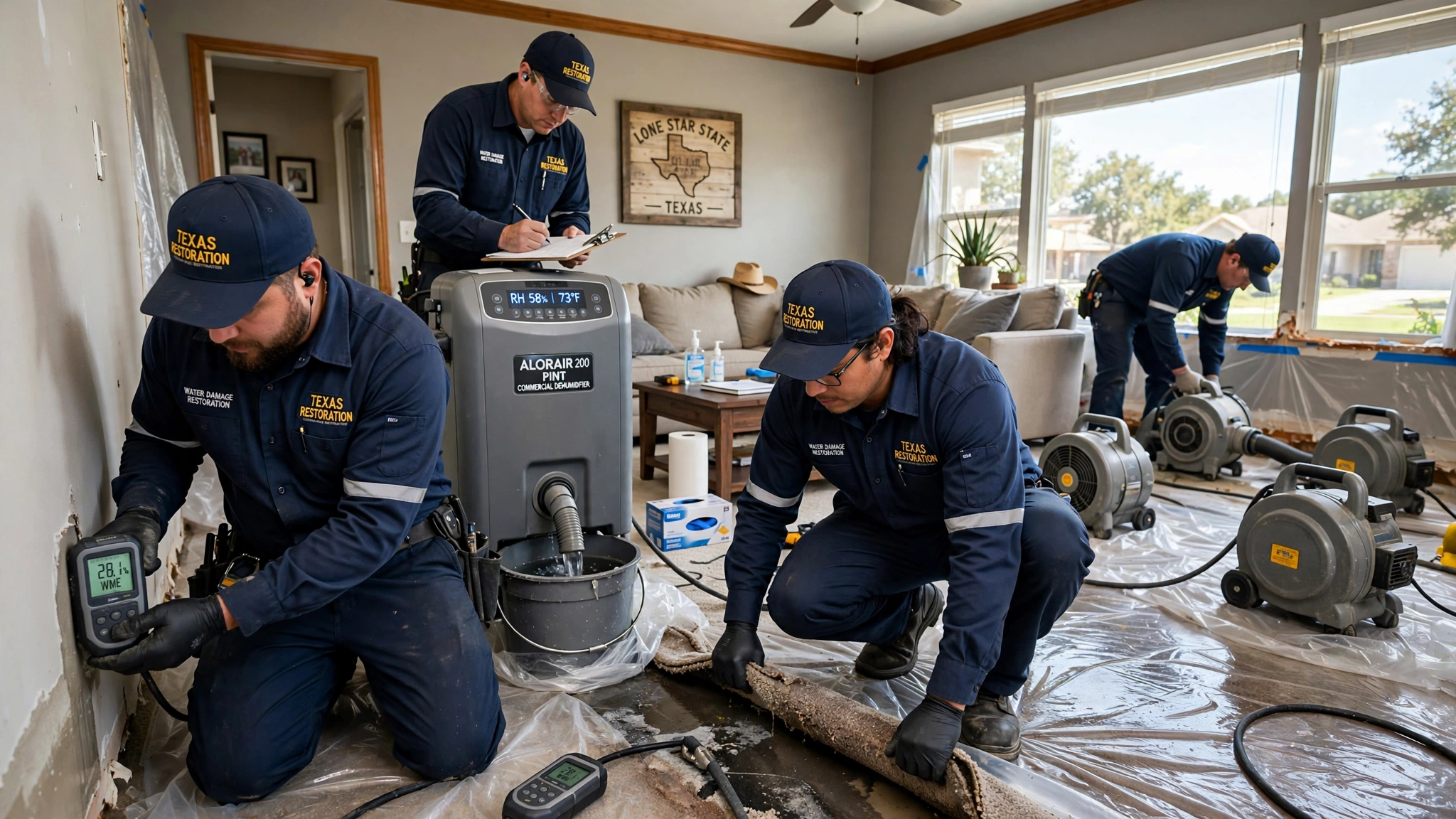
What "Water Damage Restoration" Actually Means
Most people hear “water damage restoration” and picture a shop-vac and some fans. Water damage restoration in Texas follows the same standard, adapted for Texas construction: slab-on-grade foundations, pier-and-beam Hill Country homes, stucco and brick veneer walls, and attic HVAC systems that turn a small leak into a whole-house humidity problem.
The five stages: inspection and assessment (moisture mapping with meters and thermal imaging), water extraction (removing standing water — the highest-leverage step), drying and dehumidification (bringing materials back to verified dry standards), cleaning and sanitizing (antimicrobial treatment, odor control, contents cleaning), and restoration (rebuilding what couldn’t be saved). A company that only does two of the five isn’t restoring — it’s mopping.
Every Service You Need, One Team
From emergency extraction to full rebuild — local professionals handle it all.
Emergency Water Damage Restoration
24/7 rapid response for floods, burst pipes, and storm damage.
Why Texas Water Damage Is Its Own Animal
Slab Foundations Trap Water Differently
Most Texas homes sit on slab-on-grade foundations. Water doesn’t drain to a basement — it spreads laterally under flooring and wicks up drywall. A refrigerator line leak in a Dallas slab home can saturate 400 square feet of flooring before anyone notices a damp spot. Our extraction crews map the full migration pattern, not just the visible puddle.
Heat Accelerates Everything — Including Mold
In Texas summers, the 48-hour mold window shrinks. Warm, humid air inside wall cavities is an incubator.
Storm Season Is a Calendar Event
Hurricane season (June–November) and spring severe weather mean storm-driven water intrusion is a when-not-if scenario for millions of Texas homes. We pre-stage equipment before major storms so response doesn’t wait on supply chains.
Not All Water Is Equal: The Three Categories
Category 1 — Clean water. Supply line breaks, overflowing sinks. The least hazardous, but it degrades: leave Category 1 sitting for 48+ hours and microbial growth pushes it toward Category 2.
Category 2 — Gray water. Washing machine discharge, dishwasher leaks, aquarium breaks. Contains contaminants that cause illness. Porous materials (carpet pad, drywall) exposed to gray water generally must be removed, not dried.
Category 3 — Black water. Sewage, rising floodwater, seawater. Grossly contaminated. Our sewage backup teams treat Category 3 as a biohazard: full PPE, containment, removal of porous materials, and hospital-grade disinfection of everything that remains.
Identifying the category correctly on arrival determines the entire protocol — which is why the assessment stage can never be skipped.
Restoration vs. Renovation: Know the Difference
Restoration returns your property to pre-loss condition — what insurance pays for. Renovation improves beyond it — which you pay for out of pocket. Local professionals handle the restoration scope to insurance standards and document everything your adjuster needs through our insurance claim assistance.
From structural drying to final paint, one team owns the whole job. No subcontractor roulette, no finger-pointing between the dry-out crew and the rebuild crew.
Know Exactly What Happens Next
Water damage is stressful enough. Here is the exact process local professionals follow on every job — no surprises, no guesswork.
Inspection & Moisture Mapping
We find every wet area with meters and thermal imaging — not just the visible puddle.
Water Extraction
Truck-mounted extractors remove standing water fast — the highest-leverage step of the job.
Drying & Dehumidification
Commercial air movers and dehumidifiers bring materials back to verified dry standards.
Cleaning & Restoration
Sanitizing, odor control, and full rebuild of whatever could not be saved.
Water Damage Restoration FAQs
How long does the full restoration take?
Can I clean up water damage myself?
Will my homeowner's insurance cover it?
Do you handle the rebuild too, or just dry-out?
Need Full Restoration in Texas?
Call now to get connected with a local restoration pro.
Emergency water damage restoration across Texas. Local water damage restoration professionals.